
30. 串联所有单词的子串
给定一个字符串 s 和一个字符串数组 words。 words 中所有字符串 长度相同。
s 中的 串联子串 是指一个包含 words 中所有字符串以任意顺序排列连接起来的子串。
- 例如,如果
words = ["ab","cd","ef"], 那么"abcdef","abefcd","cdabef","cdefab","efabcd", 和"efcdab"都是串联子串。"acdbef"不是串联子串,因为他不是任何words排列的连接。
返回所有串联子串在 s 中的开始索引。你可以以 任意顺序 返回答案。
示例 1:
输入:s = “barfoothefoobarman”, words = [“foo”,“bar”]
输出:[0,9]
解释:因为 words.length == 2 同时 words[i].length == 3,连接的子字符串的长度必须为 6。
子串 “barfoo” 开始位置是 0。它是 words 中以 [“bar”,“foo”] 顺序排列的连接。
子串 “foobar” 开始位置是 9。它是 words 中以 [“foo”,“bar”] 顺序排列的连接。
输出顺序无关紧要。返回 [9,0] 也是可以的。
示例 2:
输入:s = “wordgoodgoodgoodbestword”, words = [“word”,“good”,“best”,“word”]
输出:[]
解释:因为 words.length == 4 并且 words[i].length == 4,所以串联子串的长度必须为 16。
s 中没有子串长度为 16 并且等于 words 的任何顺序排列的连接。
所以我们返回一个空数组。
示例 3:
输入:s = “barfoofoobarthefoobarman”, words = [“bar”,“foo”,“the”]
输出:[6,9,12]
解释:因为 words.length == 3 并且 words[i].length == 3,所以串联子串的长度必须为 9。
子串 “foobarthe” 开始位置是 6。它是 words 中以 [“foo”,“bar”,“the”] 顺序排列的连接。
子串 “barthefoo” 开始位置是 9。它是 words 中以 [“bar”,“the”,“foo”] 顺序排列的连接。
子串 “thefoobar” 开始位置是 12。它是 words 中以 [“the”,“foo”,“bar”] 顺序排列的连接。
提示:
1 <= s.length <= 1041 <= words.length <= 50001 <= words[i].length <= 30words[i]和s由小写英文字母组成
题解
比较容易可以想到中符合要求的子串长度一定是,那么暴力的方法是:
我们假设:
- = 字符串
s的长度。 - =
words数组中单词的个数。 - = 每个单词的长度 (
gap)。
for(int i = 0; i < n; i ++){ //循环遍历s字符串
		string tmp = s.substr(i, sublength); //每次取长度sublength的子串
		if(judge(tmp)) ans.push_back(i); //判断是否符合要求
}
外层循环:执行 次;字符串截取:s.substr(i, sublength);长度为 。耗时 ,Judge 函数(假设实现): 为了判断 tmp 是否由 words 组成,通常需要:将 tmp 切割成 个长度为 的单词,构建一个新的哈希表统计频率,与原 words 的哈希表比对,构建哈希表代价: 个单词,每个插入耗时 。总计 。
总时间复杂度:$$O(N \times (M \cdot W + M \cdot W \log M)) \approx O(N \cdot M \cdot W \cdot \log M)$$ 会超时
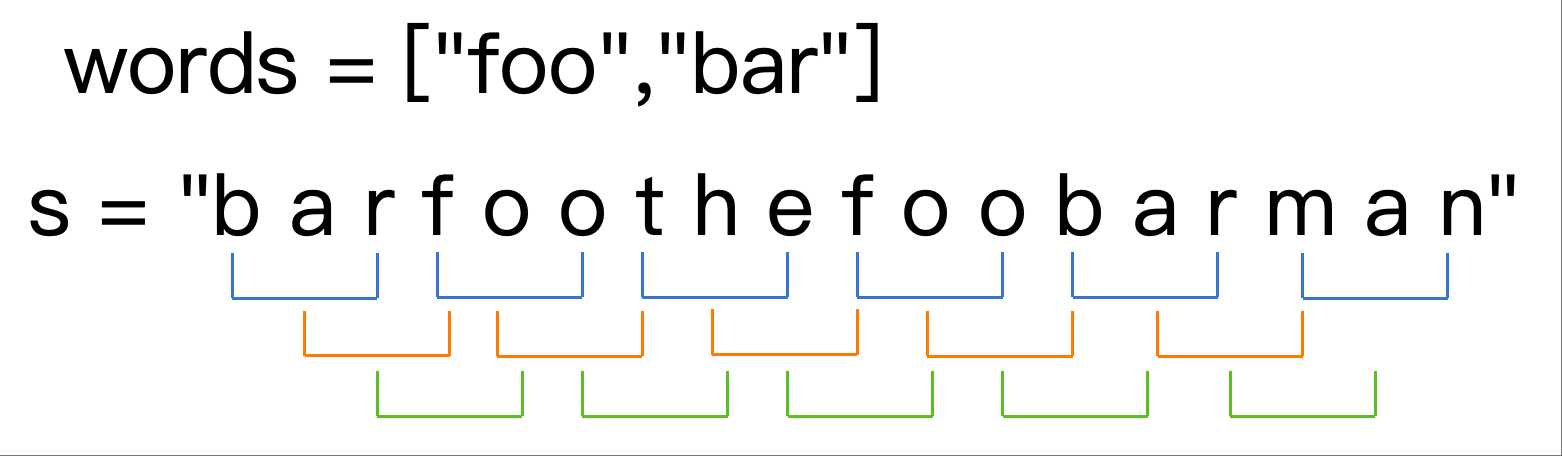
题目关键在于如何遍历所有可能的解,考虑改变外层循环为循环,即每个单词的长度,且每次循环的间隔也为,即:
for(int i = 0; i < W; i ++){
		.......
}
按照每个单词的长度进行循环,每次间隔的长度,即可遍历所有组合,再辅以双指针,初始状态在确定的“起跑线”上,l 和 r 维护一个动态窗口:
- 进窗口 (
r):r每次向右跳gap长度,截取一个新单词,加入临时哈希表hash2计数。 - 出窗口 (
l):一旦当前窗口长度(r - l + 1)超过了目标总长度(sublength),l就向右跳gap长度,把最左边的那个单词从hash2中减去。
当窗口长度正好等于目标总长度(r - l == sublength)时,触发检查逻辑。遍历标准答案 hash 中的每一个单词,去对比它在当前窗口 hash2 中的数量:如果所有单词的计数都完全一致,说明找到通过,记录 l。只要有一个单词数量对不上,就标记失败。
S:  [ a b c ] [ d e f ] [ g h i ] ...
    ^         ^
    l         r

    1. r 右移,吃进 "abc",查表记录。
    2. r 继续右移,吃进 "def",查表记录。
    3. 如果长度超标,l 右移,吐出 "abc"。
    4. 如果长度达标,对比 hash 和 hash2 是否完全相等。
代码
class Solution {
public:
    map<string, int>hash;

    vector<int> findSubstring(string s, vector<string>& words) {
        int n = s.length(), gap = words[0].size();
        int sublength = gap * words.size();
        vector<int> ans;

        for(auto &i: words){
            hash[i] ++;
        }
        for(int i = 0; i < gap; i ++){
            map<string, int> hash2;
            int l = i, r = i;
            string tmp = "";
            while(r <= n - gap && l <= r){
                string t = s.substr(r, gap);
                hash2[t] ++;
                while(r - l + 1 > sublength){
                    string out = s.substr(l, gap);
                    hash2[out] --;
                    l += gap;
                }
                r += gap;
                if(r - l == sublength){
                    bool flag = false;
                    for(auto [ss, cnt]: hash){
                        if(hash[ss] != hash2[ss]){
                            flag = true;
                            break;
                        }
                    }
                    if(!flag){
                        ans.push_back(l);
                    }
                }
            }
        }
        return ans;
    }
};